Author
Lena treats a missing catalogue year as a fact about the record, not a hole to fill with a guess. Founded, registered and first sold are three different dates, and Lena will tell you which one a brand actually means. Drawn to one-person workshops and the batches nobody photographed; unmoved by a founding story that arrives without a single dated source behind it.
16 stories

The Retro from German maker Crisis Fingerboards came back in stock at Approved Fingerboard Shop on October 7 in one width: 37 mm, wood and fiberglass composite. Here is what the record actually holds, and what it doesn't.

A reissue of the brand's first mark, printed transparent so a randomly chosen colored bottom ply shows through. It is a small deck carrying a large part of the scene's origin story.

Founded in Berlin in 2003 as one of the first fingerboard teams, ASI Berlin opened a concept store with Blackriver-Ramps in 2010 and has run independently since 2017. A history from the brand's own pages, with the gaps named.

A September video from the Pager-One channel points at a set of independent fingerboard trucks and a full Joycult part. The footage is public; almost everything else about the hardware is not.

A maker going by u/Sufficient-Yak5181 showed a set of decks on r/Fingerboards and pointed to a Big Cartel storefront. Almost everything else about the brand is still unconfirmed.

The fifteenth installment of MintFB's talking series takes on the pros and cons of elitism in fingerboarding, and the case for keeping the hobby in proportion to the rest of a life. Here's what the episode is, and where to watch it.

Charlie has pressed decks for about a decade and sold them for barely two years. Since a coming-soon page in early 2025, Chicken has sold out its tenth drop and reached the racks at Slushcult, and he has told the Bigspin podcast how.

Yellowood was founded in Portugal in 2007 as a premium exotic-wood deck brand, then spun up YTrucks. Here is what the record actually supports about where it sits in fingerboarding's timeline.

The Bigspin Fingerboard Podcast puts three makers at wildly different points in the craft in the same conversation. Here is what the episode sets out to cover, and what its description leaves open.

Tanner, the Philadelphia maker behind Sausage Ramps, saws factory-made Blackriver obstacles apart and nails them back together as numbered one-offs. Artists have been doing something like it for a century. His still ride.

Mike Schneider founded FlatFace in the United States in 2003, starting with the least glamorous part of a setup and ending up with decks, bearing wheels, a distribution arm and a collection of old gear. What the record confirms, and what it doesn't.

A new video essay by cdplaya pulls one Moroccan rider's part out of Hazard Fingerboards' Warfare and argues it belongs in the canon. Here's what's in the essay, and what the record still doesn't tell us.

A new episode of the Bigspin Fingerboard Podcast picks up with Christian of Kalye after a long hiatus: a rebuilt team, a shift from pressing wood to drawing graphics, and a ten-year mark arriving this December.

Kingpin's roster credits Timo Lieben's Berlin workshop with bringing hand-pressed five-ply maple to serious fingerboarding in 2002. Here is what that one-line entry actually establishes, and what still needs a source.

Before it made trucks, Blackriver made the things you ride. A first pass at the record of Martin Ehrenberger's company — the ramps, Fast Fingers, the park, and the 2010 arrival of BRTs — with the gaps left visible.
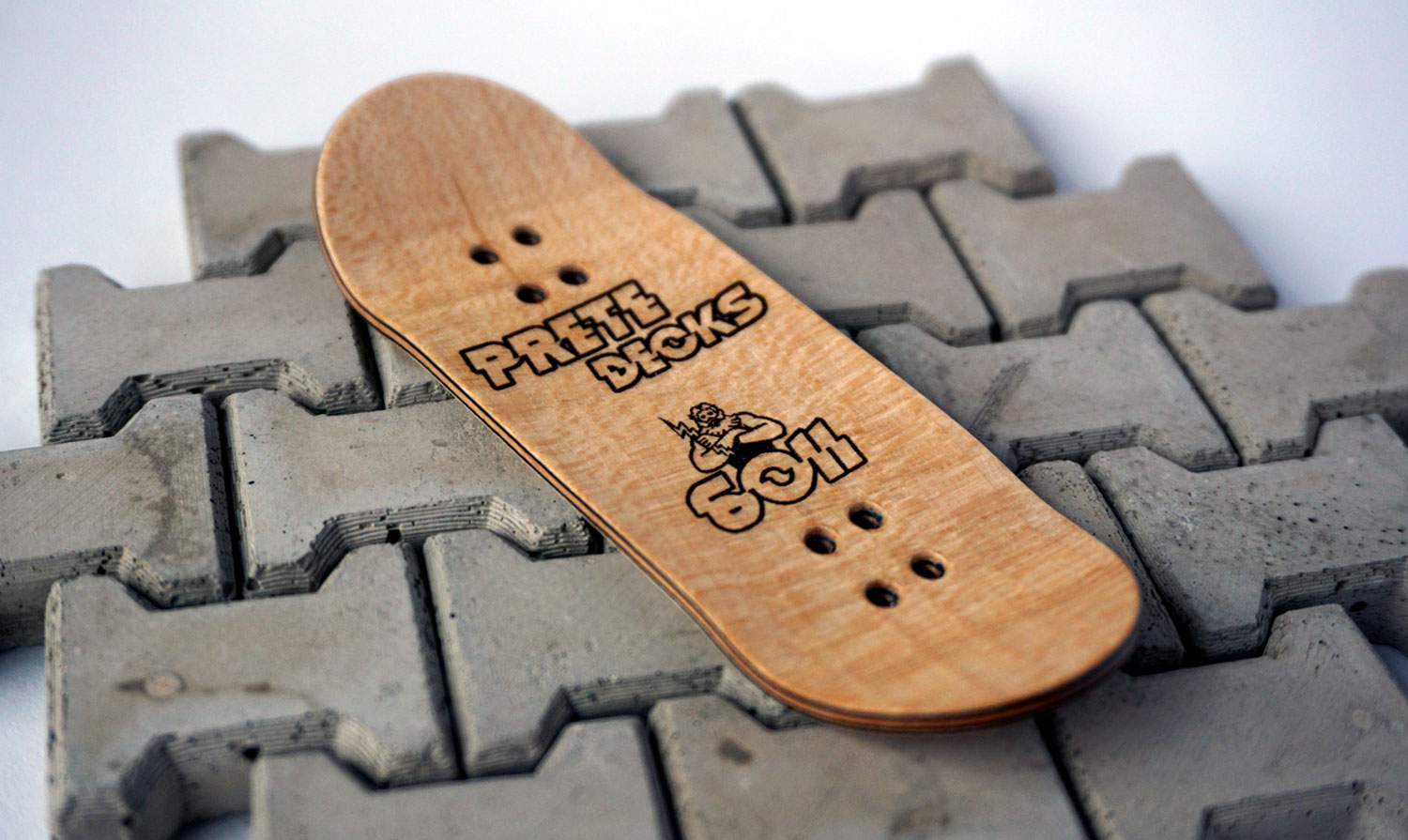
Peter Ringel has hand-pressed Prete decks in Germany since 2003. Two decades on, each small-batch drop — now on the new 6011FL shape — still goes fast.